Fish and Wildlife Technology
Associate in Applied Science (A.A.S.)
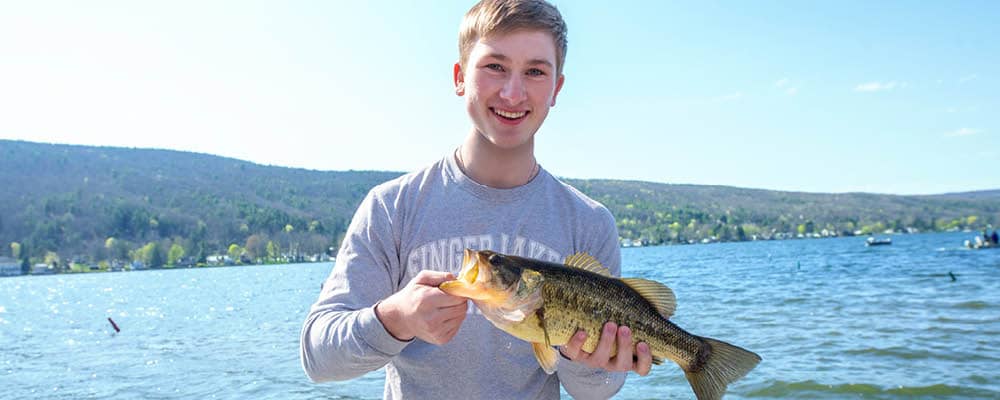
Discover the importance of our ecosystem while learning how to manage natural resources wisely. You'll gain first-hand experience studying and protecting wildlife throughout the Finger Lakes region using professional sampling equipment.
Career Outlook: Fish & Wildlife Management
Fish and wildlife professionals often work for federal, state, and local government agencies, such as the Department of Environmental Conservation. Job opportunities include permanent, full-time positions and seasonal work during the summer. The average annual salary for wildlife management jobs in New York was $45,400 in 2022.
A.A.S. Program Overview
Take an active role in conserving our community's natural resources with a degree in fish and wildlife technology. Courses in resource management focus on the science of conservation, while field training provides hands-on experience with wildlife research tools. You'll travel throughout the Finger Lakes to observe fish, plants, and animals in their natural habitats.
By the end of the program, you'll know how to perform a variety of ethical sampling techniques, identify plants and animals, and prepare field reports using data you collected.
Outdoor Education and Research Facilities
Study in our research facilities designed for environmental and wildlife education. FLCC's main campus in Canandaigua has an on-site arboretum and greenhouse, as well as multiple wildlife observation blinds. The 250-acre campus is home to second-growth woodlands, wetlands, nature trails, and fields in various states of natural succession. You'll even spend time on the water, joining your classmates and FLCC faculty on our research vessels — including a state-of-the-art electrofishing boat.
You'll receive an exceptional outdoor learning experience at our two field stations in the Finger Lakes, including:
- The Muller Field Station, located on the southern end of Honeoye Lake, where you can participate in lab work, help in the fish hatchery, and engage in community outreach and local research projects.
- The East Hill Campus, located near the High Tor Wildlife Management area in Naples, where you can take part in camping, hiking, wildlife, and nature classes.
Hands-On Field Work
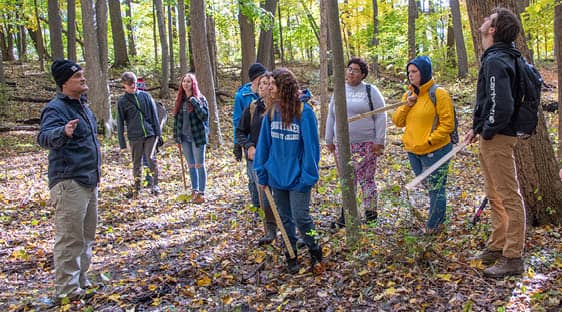
Develop wildlife research methods you'll use regularly in your future fish and wildlife career. Learn how to safely trap small mammals, raise and stock walleye, band birds, and survey amphibian populations. You'll also set up wildlife cameras, collect data, analyze your findings, and create sustainable management plans based on your observations.
Gain experience with a variety of industry technology including sampling devices, tagging equipment, nets, and camera traps.
A.A.S. Program Outcomes
Program Learning Outcomes
Upon completion of this degree program, students will be able to:
- Identify predominant regional species (e.g. plant, fish, mammal, bird) and their natural histories.
- Apply ethical principles for treatment of animals.
- Apply best management principles (BMPs) for the management of natural resources.
- Practice essential career skills (e.g. operate equipment) commonly used in the natural resources field.
Career Pathways
With a degree in fish and wildlife technology, you'll be ready for natural resource management positions with state, local, and federal agencies. You'll also find job opportunities with private fish hatcheries, wildlife preserves, and environmental consulting firms.
Some careers include:
- Fish and Wildlife Technician
- Fish Culturist
- Aquaculture Technician
- Hatchery Technician/Operator
- Fish and Wildlife Biologist
- Nuisance Wildlife Control
- Environmental Educator
Graduates often begin their careers with one of the many government agencies dedicated to preserving our natural resources, including:
- Bureau of Land Management
- Department of Health
- Department of Environmental Conservation
- Natural Resources Conservation Service
- National Park Service
- U.S. Fish and Wildlife Service
Seamless Transfer Opportunities
Some of our graduates continue their fish and wildlife education at four-year schools, including:
- Cornell University
- Paul Smith's College
- Rochester Institute of Technology
- SUNY Brockport
- SUNY Cobleskill
- SUNY Stony Brook
Low-Cost Tuition and Scholarship Opportunities
Earn a quality education at an affordable rate. With our low cost-per-credit and general scholarship opportunities, you can maximize your potential with minimal debt. 80% of students are awarded scholarships or financial aid that help with the cost of college.
As a fish and wildlife technology student, you may also be eligible for the following program-specific scholarships:
- Robert L. (Rodge) Case Award
- FLCC Conservation Faculty Award
- Francis Finnick Memorial Conservation Award
- Fraley Family Award
To learn about these scholarships, contact the FLCC Foundation.
Faculty
Our fish and wildlife faculty have a wide range of environmental expertise. They have earned graduate degrees from institutions such as Lehigh University, SUNY Brockport, and SUNY College of Environmental Science and Forestry. Complementing decades of experience teaching at the college level, our faculty have lived all over the country working in the conservation field.
Adjunct faculty teach specialty classes, with diverse backgrounds that include resource professionals for the U.S. Fish and Wildlife Service and the New York State Department of Environmental Conservation.
Field Stations
Our two field stations provide exceptional outdoor learning experiences for students.
The Muller Field Station (near Honeoye Lake) hosts laboratory experiences, community outreach, and local research projects.
The East Hill Campus (near Naples) is an outdoor facility for camping, hiking, wildlife, and nature classes.
Related Programs
Check out our other environmental science and conservation programs:
Program Details

Explore Your Career Options
Map out a path toward your future career, and discover opportunities related to this area of study.